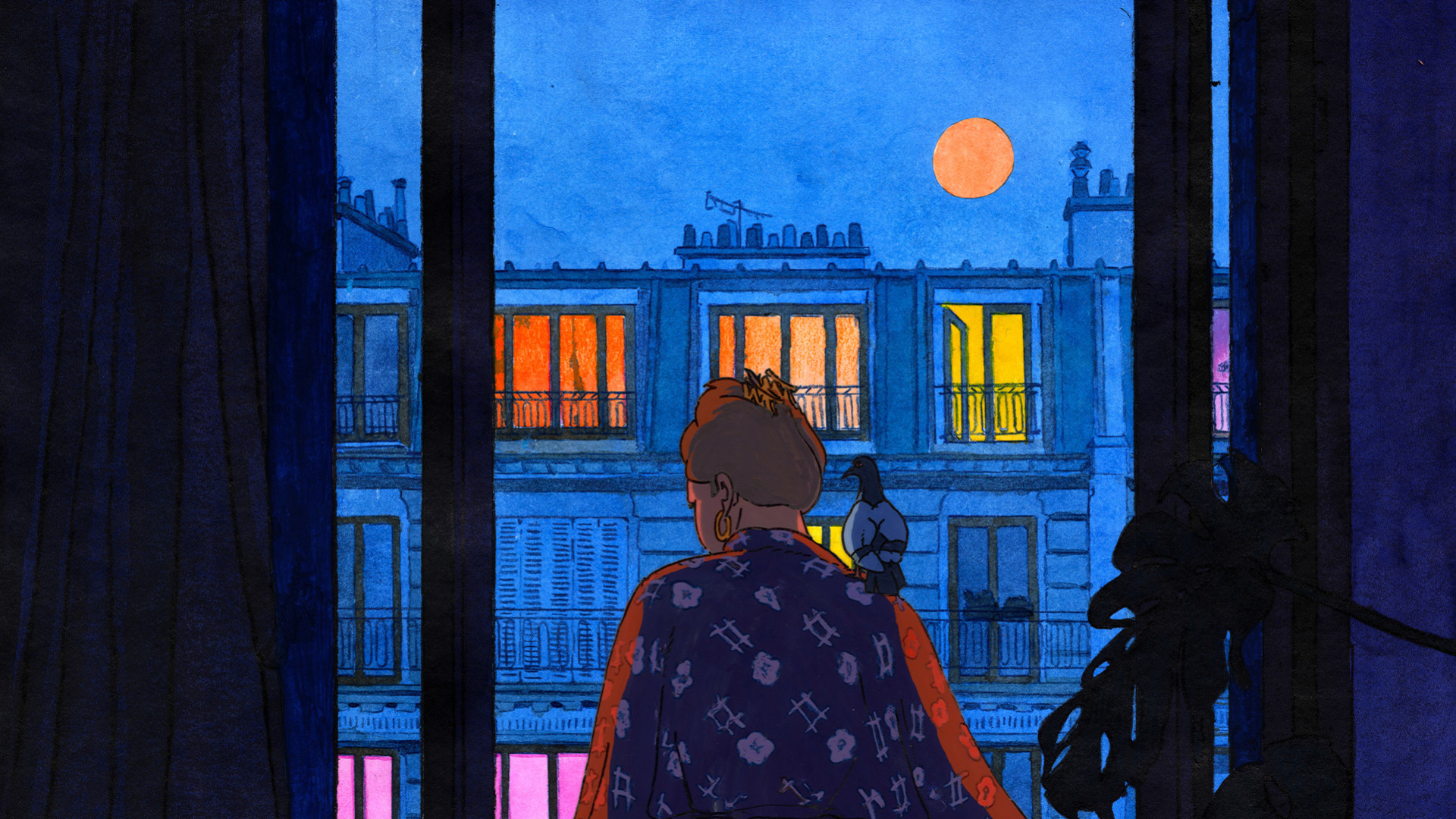
From the fifth floor, Paris doesn’t quite look the same anymore. The city recedes from its hustle and bustle to become a landscape of lit windows, nocturnal facades, and silhouettes captured in the rhythm of everyday life. With *Le cinquième étage*, the SLOW Galerie invites Paul Duru to turn his gaze toward the city where he was born—a city he never ceases to observe, explore, and sketch.
The exhibition brings together three complementary series: the interiors of small Parisian apartments, the city at night in the rain, and a series of small-format works conceived as a travel journal within Paris. Between the warmth of refuge and the hostility of the outside world, the window becomes a passageway from one world to another.
The fifth floor marks a turning point in the exhibition. It connects two facets of Paris that Paul Duru knows intimately and which, despite their apparent contrast, remain inseparable when living in the capital: the interior and the exterior, light and shadow. Neither quite at the heart of the street nor completely removed from the world, this floor offers a privileged vantage point. The views open up, the noise fades, and one’s attention turns to scenes that we eventually stop noticing because they are part of everyday life: a room shaped by its inhabitant, laundry drying, a reflection on a wet sidewalk, or a window that lights up at dusk.
The first section of the exhibition pays tribute to small Parisian apartments: attic rooms, spaces where every square meter is maximized, and those reached after climbing five flights of stairs without an elevator. Paul Duru drew inspiration from his own apartment, which bears the marks of his daily routines and tells a story of his life.
“It’s a kind of portrait, but a portrait set against a backdrop,”
the artist explains.
Created in ink using a warm color palette, these drawings focus on the details that give a place its character: a cup of tea, a meal set on a coffee table, accumulated objects, or laundry hanging to dry. Through the windows, one sees rooftops, neighboring buildings, sunsets, and the other inhabitants of the fifth floor: the pigeons, whom the artist observes just as much as they seem to observe him. For the first time in his work, Paul Duru introduces figures into his illustrations. He paints them on celluloid, a transparent medium inherited from traditional animated film, then superimposes them onto the setting. This technique allows the apartment to exist independently of those who pass through it. Whether present or absent, the human figure does not alter the central role assigned to the space: the residents come and go, while the apartment remains and continues to live through the changing light of day and night.
The warmth of the interiors contrasts with a nocturnal, rainy, and more hostile city. After spending a long time drawing Paris in the sunshine and late-afternoon light, Paul Duru now turns his gaze to artificial lights: traffic lights, car headlights, and windows that light up as soon as the day ends in winter. In the rain, these light sources refract across sidewalks, windshields, and windows covered with raindrops. The colors blend together, pushing back the darkness and revealing a city in motion, perceived in flashes. For this series, presented in larger formats, the artist abandons the precision of paper in favor of felt worked with colored pencils. The medium forces her to set aside detail—though central to her practice—in order to think in terms of masses of color. The forms dissolve, leaving only dominant reds, yellows, or greens in the memory, as when one runs through the city in the pouring rain.
A final series brings together small-format works devoted to scenes and details he has observed in recent years, both indoors and outdoors. Derived from sketches or photographs taken at random during his travels, they hark back to the travel sketchbook, one of Paul Duru’s favorite formats. This time, the journey takes place in the city where he was born. These works punctuate the exhibition like moments of respite among the large-scale nocturnal pieces. They draw the viewer’s gaze back to the subtle poetry of everyday life and bring the exhibition full circle to the movement that structures it: leaving the apartment, facing the city, and then returning to that refuge, however cramped it may be.